About Apple Jack's
A roadhouse in the redwoods, serving cold beers, live music, and good company for over a century.
More Than Just a Bar
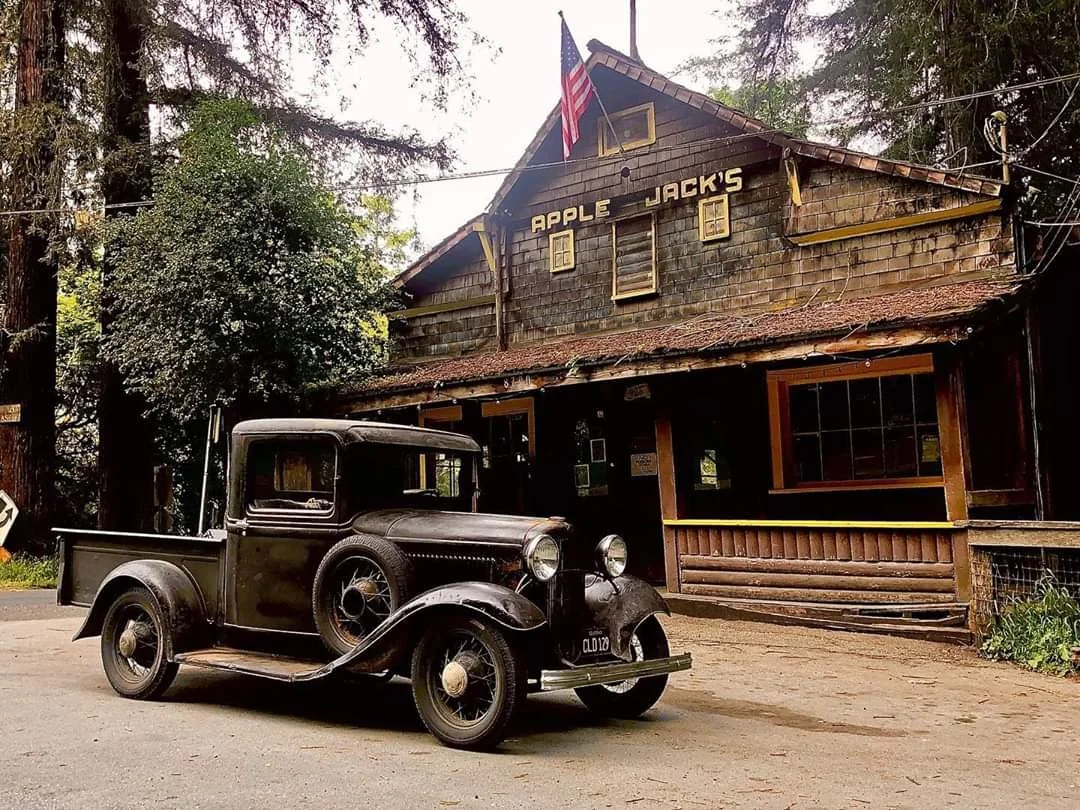
Tucked along a winding stretch of Highway 84, deep in the Santa Cruz Mountains, Apple Jack's is a place that time hasn't quite reached. The moss-covered log cabin, the creaking floors, the vintage license plates lining the roof, everything here is real, earned through more than a century of hard living and good times.
For the locals, the weekend bikers, and the occasional traveler coming home from the coast, Apple Jack's is more than a random stop along the highway. It's a roadhouse in the truest sense, a place where you put your phone down, grab a cold beer, and talk to the person next to you.
"Come in and have a drink first. Be a human being."
, A regular, to every newcomerRooted in the Redwoods Since 1880
Before Apple Jack's was a bar, before it was a blacksmith shop, La Honda was outlaw country. In the late 1800s, Cole Younger and his brothers Jim and Bob, who had ridden with the Jesse James gang, came west and hid out in La Honda. Jim and Bob Younger actually worked at a store just up the street from the present-day bar, a building locals still call the "bandit-built" store. We don't usually think of cowboys and outlaws as part of Silicon Valley history, but they were here first.
Apple Jack's began its life in 1880 as a blacksmith shop, hammering horseshoes and servicing the lumber mills that dotted the Santa Cruz Mountains. The building was connected to John Howell Sears, a prominent early La Honda figure who hired the town's blacksmith. The shop later served as Sears' grocery store before John Gabrielli saw something more in the old log building in 1920 and transformed it into the original Apple Jack's Inn. The name came from what it was known for: making its own hard cider. It was a place where loggers, ranchers, and riders along La Honda Road could stop in for a drink, and it was once even called the Old Cider Mill.
In 1949, Babe and Fred Kotoff took over and kept it exactly the way it was, no renovations, no modernization, just honest drinks in an honest building. That tradition continued when Claude and Kayla McMills bought the bar in 1978. In 1990, the McEvoy family purchased Apple Jack's from the McMills, carrying the torch forward and preserving the character that has made this place a landmark for generations.
Apple Jack's is recognized as part of California Historical Landmark #343, the "Old Store at La Honda," located at the corner of La Honda Road and Sears Ranch Roads on State Highway 84. This state-level designation, alongside a historical marker erected in 1978 by the San Mateo County Historical Association, makes Apple Jack's one of the most historically significant bars on the entire Peninsula.
Where the Beats Met the Hippies
To understand Apple Jack's, you have to understand La Honda. This tiny hamlet in the redwoods, fewer than a thousand people, no stoplights, no chain stores, has played an outsized role in American cultural history. In the early 1960s, author Ken Kesey moved to a cabin just up the road after the success of One Flew Over the Cuckoo's Nest. What followed changed everything.
Kesey's La Honda property became the headquarters of the Merry Pranksters, the infamous band of artists, writers, and free spirits who helped bridge the gap between the Beat Generation and the hippie movement. It was here that they loaded up Furthur, their wildly painted school bus with Neal Cassady at the wheel, and set off on the cross-country trip that Tom Wolfe would immortalize in The Electric Kool-Aid Acid Test. It was here that they hosted the first Acid Tests, with the Grateful Dead (then still called the Warlocks) playing their earliest psychedelic sets. And it was here, in the summer of 1965, that Hunter S. Thompson introduced the Pranksters to the Hell's Angels for a legendary party in the woods.
Apple Jack's was the local watering hole through all of it. When the Pranksters needed a break from painting the trees Day-Glo colors, when the bikers rolled through on weekends, when the writers and musicians who populated these hills wanted a cold beer and a game of pool, they came here. The bar didn't change for the counterculture, and it didn't change after it. That's the point.
Neil Young, Joan Baez & the Sound of These Hills
In 1970, a 24-year-old Neil Young, fresh off the success of Crosby, Stills, Nash & Young and the landmark album Déjà Vu, purchased a sprawling ranch in the hills between La Honda and Woodside. He named it Broken Arrow, after the Buffalo Springfield song, and it became one of the most storied recording locations in rock history.
Young wrote "Old Man" about the ranch's longtime caretaker and recorded Harvest, Tonight's the Night, and countless other albums in a converted barn on the property. For more than five decades, Broken Arrow Ranch has drawn legends to these mountains, Bob Dylan, Joni Mitchell, Pearl Jam, and many others have recorded within its walls. The rural character of La Honda that drew Young here in 1970 is the same quality that keeps Apple Jack's what it is today.
Joan Baez lived at a nearby commune called The Land, and her connection to Apple Jack's was direct. When she needed masonry work done, she showed up at the bar with a pickup truck full of bricks and beer to hire "Limey Kay," a legendary La Honda eccentric and the area's go-to bricklayer. Limey did work for both Baez and Neil Young, and Apple Jack's was where you found him. The folk music scene that flourished in the Santa Cruz Mountains throughout the '60s and '70s added another layer to La Honda's reputation as a haven for artists and free thinkers. That spirit is still alive every weekend when bands plug in on our stage.
No Frills. All Soul.
Apple Jack's has everything a great roadhouse needs and nothing it doesn't. A well-worn pool table, a jukebox full of classic rock, cold beer, and stiff drinks. The floors creak with more than a hundred years of stories, and the walls hold more history than most museums on the Peninsula.
On weekends, local and touring bands play live music that spills out onto the deck and into the redwoods. Motorcycle clubs stop in on their weekend runs. Families wander over from a day at the coast. Everyone is welcome, just be ready to put the phone away and have a conversation.
A Place to Be a Human Being
But for the locals, groups of bikers out on their weekend runs, and the occasional tourist coming home from a day near the coast, Apple Jacks is more than just a random stop along the highway. It's an experience all its own.
With its secluded setting, an adornment of vintage license plates lining the roof, and the reputation for being a resting spot for various groups of bikers throughout its history, Apple Jacks is more of a roadhouse than a dive bar. Don't get me wrong. It has all the qualities that encompass a good dive as well: a rugged pool table that's missing the cueball, a classic rock-churning jukebox, a food menu of assorted candy bars and chips, and a no-frills beer and liquor selection that is meant to get you drunk, not expand your flavor palate.
It might seem silly to make a trek all the way out to a secluded bar just for a basic drink. But Apple Jacks has a certain trait that the new-fangled industrial gastropubs in the Mission and Financial Districts only attempt to recreate: it has authenticity. The floors squeak from age. The interior looks were almost unchanged from when it was built over 140 years ago.
A tight-knit community of bar patrons will immediately know you're not from around there. But don't worry, you'll be accepted if you can adhere to their way of doing things. As my girlfriend tried to take photos of the front of the bar after we pulled up, she was immediately shouted down. "Come in and have a drink first," yelled a tall, elderly man in a stern and affirmative manner. "Be a human being."
By the end of the night, the principled veteran had told us all about his adventures riding motorcycles around the country, owning a bar at age 17, and had even invited us over to his house for a two-day party. All we had to do was cut our teeth in a game of liar's dice.
Apple Jacks is an old soul trapped in an even older log cabin. Where drinking your beer and making conversation with the person on the barstool next to you is favored over taking a picture of it and putting it on Instagram. In the words of the tall gentleman, Apple Jacks is a place to be a human being.
The Gun on the Bar
Limey was the area's go-to craftsman. Joan Baez hired him by showing up at Apple Jack's with a pickup truck full of bricks and beer. Neil Young used him for masonry work at Broken Arrow Ranch. If you needed something built in these mountains, you went to the bar and found Limey.
But Limey had a temper to match his talent. With Hells Angels regularly passing through La Honda on their way to and from Kesey's property, and with Limey's fondness for guns, motorcycles, and alcohol, trouble was inevitable. One day, Limey held a gun to the head of a Hells Angel.
For weeks afterward, Limey was on the lam, hiding out in the hills as the Angels hunted for him. The Hells Angels didn't let that kind of thing go. Back in Oakland, their leader was Sonny Barger, the man Hunter S. Thompson called "the Maximum Leader," the founding member who had unified the club's scattered charters into a single organization and who had personally led the attack on anti-war protesters in Berkeley that same decade.
It was Limey's wife, Nancy Kay, who saved him. She reached out to her old friend Sonny Barger directly and asked for mercy. Barger, the most feared biker in California, agreed. He personally called off the manhunt, and Limey came out of hiding.
But Limey being Limey, he didn't exactly come back quietly. For a while afterward, he carried a pearl-handled .44 Magnum revolver with a single bullet in it, kept loose in his pocket. Local residents still remember the day Limey walked into Apple Jack's, laid the gun on the bar, and demanded a beer.
That was La Honda in those years. Folk royalty hiring bricklayers over a truckload of beer. Rock legends recording albums up the hill. Hells Angels partying with the Merry Pranksters down the road. And at the center of all of it, a moss-covered log cabin where a man could lay a .44 Magnum on the bar and nobody batted an eye.
On Screen & Beyond
Walking Dead stars Norman Reedus and Steven Yeun rode through the Bay Area on motorcycles, exploring the Northern California coastline from La Honda to Sonoma. Along the way they stopped in at Apple Jack's, joining a lineup of memorable stops that included skateboarding legend Max Schaaf, Primus frontman Les Claypool, and the historic East Bay Dragons motorcycle club. The episode aired February 17, 2019 on AMC and is available to stream on AMC+.
Directed by Jeff Hammer, this indie film-noir thriller was shot almost entirely in the hills south of Half Moon Bay, with La Honda, San Gregorio, and Pescadero all featured prominently. Apple Jack's appears directly in the film — the femme fatale character Vic works as a bartender here, and there's a scene where she heckles a cyclist for using the restroom without buying anything. Hammer described Apple Jack's as "central to the town, both physically and spiritually." The production even gave a few speaking roles to locals — sometimes the bartender in a scene was from the bar's actual staff.
EA's legendary motorcycle racing and combat series was born right in Apple Jack's backyard. EA was headquartered in San Mateo, directly over the mountain, and the development team's local roads — Highway 84 and Skyline Boulevard — ran right past the bar's front door. The original game's "Peninsula" track mirrors the winding, redwood-lined character of La Honda Road. In the landmark 1994 3DO version, live-action video sequences were filmed with local riders, and the winner, loser, and "busted" clips show Apple Jack's distinctive log cabin facade in the background. The game's biker bar hub bears a striking resemblance to the real thing. During filming, a loaner Ducati Supersport 900 was accidentally laid down and scratched beyond return — it still sits on display at EA to this day. The series sold over 3 million copies and remains a cult classic.
Apple Jack's made it to national television in this commercial for rheumatoid arthritis medication Rinvoq. The spot follows a motorcycle rider through scenic routes, and our bar appears along the way. Spot our bar in the commercial next time it airs.